/AI ENGINEERING
BakhabarAI — Crisis Intelligence & Response Orchestrator
Multi-agent crisis intelligence system for Pakistani urban environments, combining live signals, AI-driven incident analysis, resource planning, simulations, and real-time mobile response.
- My role
- AI Engineer / Full-Stack Developer — Team Solvit
- Tools & technologies
- Google ADK, Gemini 2.0 Flash, Groq, Llama 3.1 8B, FastAPI, Flutter, Dart, Firebase, Firestore, Google Maps API, Google Weather API, Dio, Provider, Multi-Agent Systems, Agentic AI, Crisis Intelligence, Real-Time Systems
- Data
- live
- Explore
- View GitHub


Overview
BakhabarAI is a full-stack, multi-agent crisis intelligence and response system designed for Pakistani urban environments.
It was developed by Team Solvit for the Google AI Seekho Antigravity Hackathon 2026 under the CIRO Challenge.
The system addresses a key problem in emergency management: crisis information often arrives from fragmented sources such as weather feeds, citizen reports, sensors, emergency calls, and field teams. BakhabarAI brings these signals together, processes them through a coordinated AI pipeline, and converts them into structured crisis intelligence for decision-makers and responders.
The Problem
During urban emergencies, response teams need to quickly answer several questions:
- Is the reported incident real?
- How severe is it?
- How many people may be affected?
- Which resources should be dispatched?
- What trade-offs exist when multiple incidents happen at once?
- What should different stakeholders be told?
- How might conditions improve after intervention?
Traditional rule-based systems struggle when signals are incomplete, noisy, contradictory, or arriving from several sources at the same time.
BakhabarAI was designed to provide an agentic workflow that can process these signals step by step while maintaining real-time visibility in a mobile application.
Solution Architecture
The platform combines a Flutter mobile application with a FastAPI backend and Firebase Firestore real-time data layer.
The backend processes crisis signals using a five-stage multi-agent pipeline built with Google ADK.
The mobile application receives incident, resource, simulation, and agent-trace updates directly from Firestore streams, eliminating the need for constant polling.
Multi-Agent Pipeline
1. Signal Fusion Agent
The first stage processes incoming crisis signals from sources such as:
- Citizen reports
- Social-style reports
- Emergency call transcripts
- Field reports
- Sensor telemetry
- Weather information
Signals are evaluated using credibility scores and crisis-related keywords.
The system also includes deduplication logic to prevent already processed or verified signals from being handled repeatedly.
2. Crisis Detection Agent
The detection stage enriches active incidents with additional crisis intelligence such as:
- Severity
- Estimated affected population
- Expected duration
- Predicted incident evolution
LLM-generated classifications are combined with deterministic fallback logic so that the pipeline can continue even when model APIs are unavailable.
3. Resource Planning Agent
The Resource Planner assigns emergency resources based on incident severity and availability.
A deterministic priority strategy is used:
- HIGH severity incidents receive the highest allocation priority
- MEDIUM severity incidents receive secondary priority
- LOW severity incidents receive the smallest allocation
This stage also generates a trade-off explanation when several crises compete for the same limited resource pool.
4. Impact Simulation & Stakeholder Communication
The simulation stage models the expected effect of the coordinated emergency response.
For each incident, it generates:
- Before-response state
- After-response state
- Improvement metrics
- Public notifications
- Hospital notifications
- Utility-provider notifications
- Law-enforcement notifications
The system also supports bilingual public messaging, including Roman Urdu alerts for local accessibility.
5. Final Reporting
The final stage summarizes the active crisis situation and records the overall pipeline status.
Agent actions are logged throughout the pipeline so that users can inspect how each stage contributed to the final response.
Hybrid Intelligence Approach
A key design decision in BakhabarAI was not to use LLMs for every operation.
The system combines:
Deterministic Logic
Used for:
- Resource allocation
- Signal credibility scoring
- Database operations
- Incident deduplication
- Structured fallbacks
LLM Reasoning
Used for:
- Crisis classification
- Impact narrative generation
- Stakeholder communication
- Contextual reasoning
This hybrid approach reduces unnecessary model dependence while preserving AI capabilities where reasoning and language generation provide the most value.
Graceful Degradation
Each LLM-dependent stage includes a deterministic fallback.
If Groq or Gemini becomes unavailable or encounters rate limits, the pipeline can continue using predefined logic and templates.
The architecture also uses a multi-key Groq pool and Gemini fallback strategy to improve resilience.
Real-Time Firebase Architecture
Firebase Firestore acts as the real-time communication layer between the FastAPI backend and Flutter mobile client.
Core collections include:
- incidents
- signals
- resources
- action_simulations
- agent_logs
The Flutter application listens directly to Firestore streams so incident changes, resource allocations, simulations, and agent traces can appear without manual refreshes.
Citizen Incident Reporting
Users can submit incident reports directly from the mobile application.
A report can contain:
- Location
- Incident description
- Incident type
- Media
- GPS information
The backend geocodes the reported location, immediately creates a preliminary incident, stores the signal, and starts the crisis-processing pipeline asynchronously.
This allows the incident to appear in the interface quickly while deeper AI analysis continues in the background.
Google Maps & Location Intelligence
BakhabarAI integrates several Google Maps Platform services:
- Geocoding
- Directions
- Distance Matrix
- Places Autocomplete
- Reverse Geocoding
- Google Maps Flutter SDK
These services support incident positioning, resource travel-time calculations, route generation, map interaction, and citizen location entry.
Weather Intelligence
The system integrates Google Weather data to bring current environmental conditions into the crisis pipeline.
Weather information can help validate or challenge other incoming signals, particularly for scenarios such as flooding, heatwaves, and severe weather events.
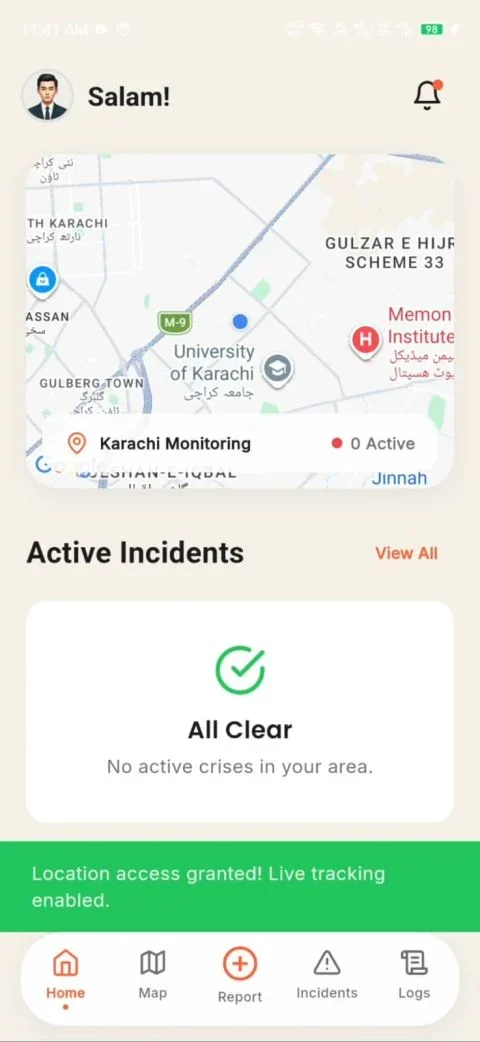
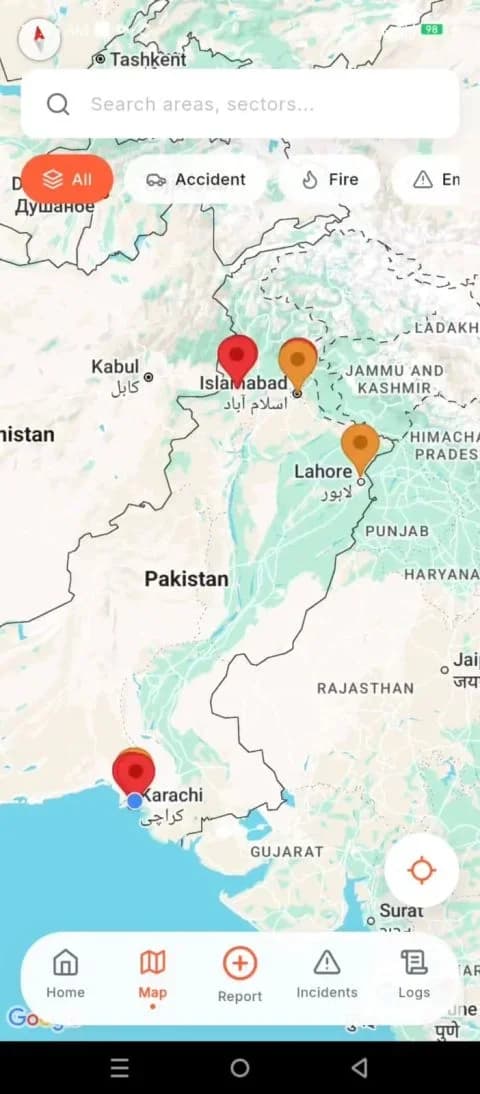
Mobile Application
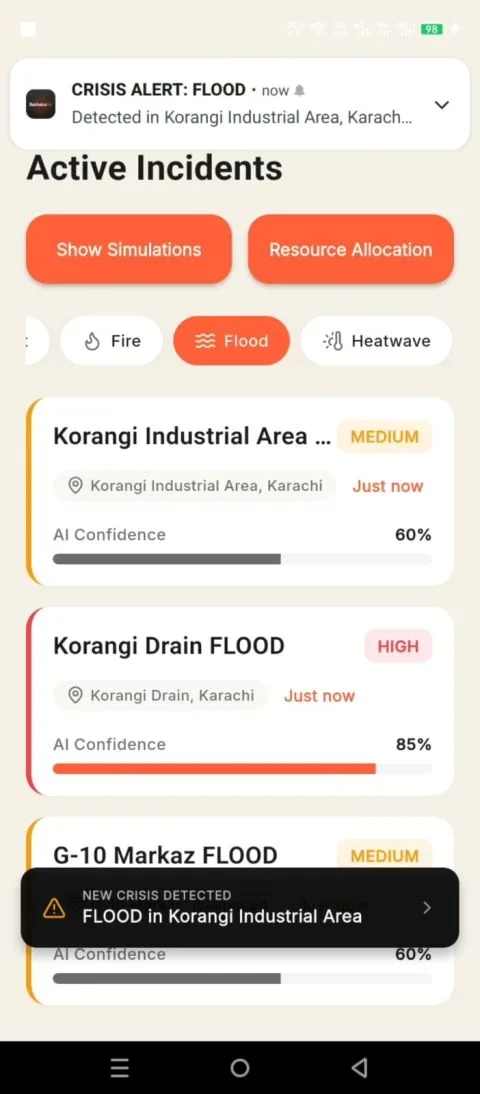
The Flutter application provides a real-time operational interface with screens for:
- Crisis overview
- Interactive incident map
- Active incidents
- Incident details
- Resource allocation
- Before/after simulations
- AI assistant
- Agent trace logs
- Citizen incident reporting
Severity is visually represented through HIGH, MEDIUM, and LOW classifications, while map markers and incident cards update through Firestore streams.
Demo Scenarios
Three crisis scenarios were designed to demonstrate different system behaviors.
Urban Flood
A high-severity flood scenario in G-10, Islamabad demonstrates incident detection, resource assignment, simulation, and emergency alerts.
Multi-Crisis Response
A simultaneous flood and heatwave scenario demonstrates how the system prioritizes limited emergency resources across incidents of different severity levels.
False Alarm Detection
A conflicting-signal scenario demonstrates how lower-confidence incident reports can be challenged by more credible evidence, allowing the system to reduce confidence and avoid unnecessary escalation.
What I Learned
BakhabarAI gave me hands-on experience building a multi-agent system that combines AI reasoning with deterministic operational logic.
The project also involved integrating real-time databases, external APIs, mobile development, location intelligence, asynchronous backend processing, agent tracing, fallbacks, and crisis-oriented decision workflows into a single system.
It demonstrated how agentic AI can be used not only for conversational applications, but also for structured, real-time operational decision support.
Limitations & context
BakhabarAI was developed as a hackathon solution and currently demonstrates crisis-response workflows through a combination of live external APIs and simulated emergency signals.
Some data sources — including social reports, emergency calls, field reports, and sensor telemetry — are simulated because direct access to municipal emergency-management systems was not available during development.
The crisis scenarios are designed to demonstrate system behavior rather than represent live emergency operations.
The current mobile application is configured primarily for Android testing, with the FastAPI backend typically accessed through a local network during development.
Real-world deployment would require integration with verified emergency-service data sources, municipal infrastructure, production authentication, secure operational policies, and formal validation with emergency-management stakeholders.
The system should therefore be viewed as a functional crisis-intelligence prototype rather than an official public-safety or emergency-dispatch platform.