/AI ENGINEERING
Voice AI Patient Registration System
A conversational Voice AI system that automates patient registration and record updates through real-time phone calls, validated data capture, and a live admin dashboard.
- My role
- AI Engineer & Backend Developer
- Tools & technologies
- Python, FastAPI, Vapi, OpenAI, Soniox, Supabase, PostgreSQL, Pydantic, Render, REST API, Voice AI, Conversational AI, Telephony
- Data
- Sample / demonstration data
- Explore
- View GitHub Live project
A look at the project
Overview
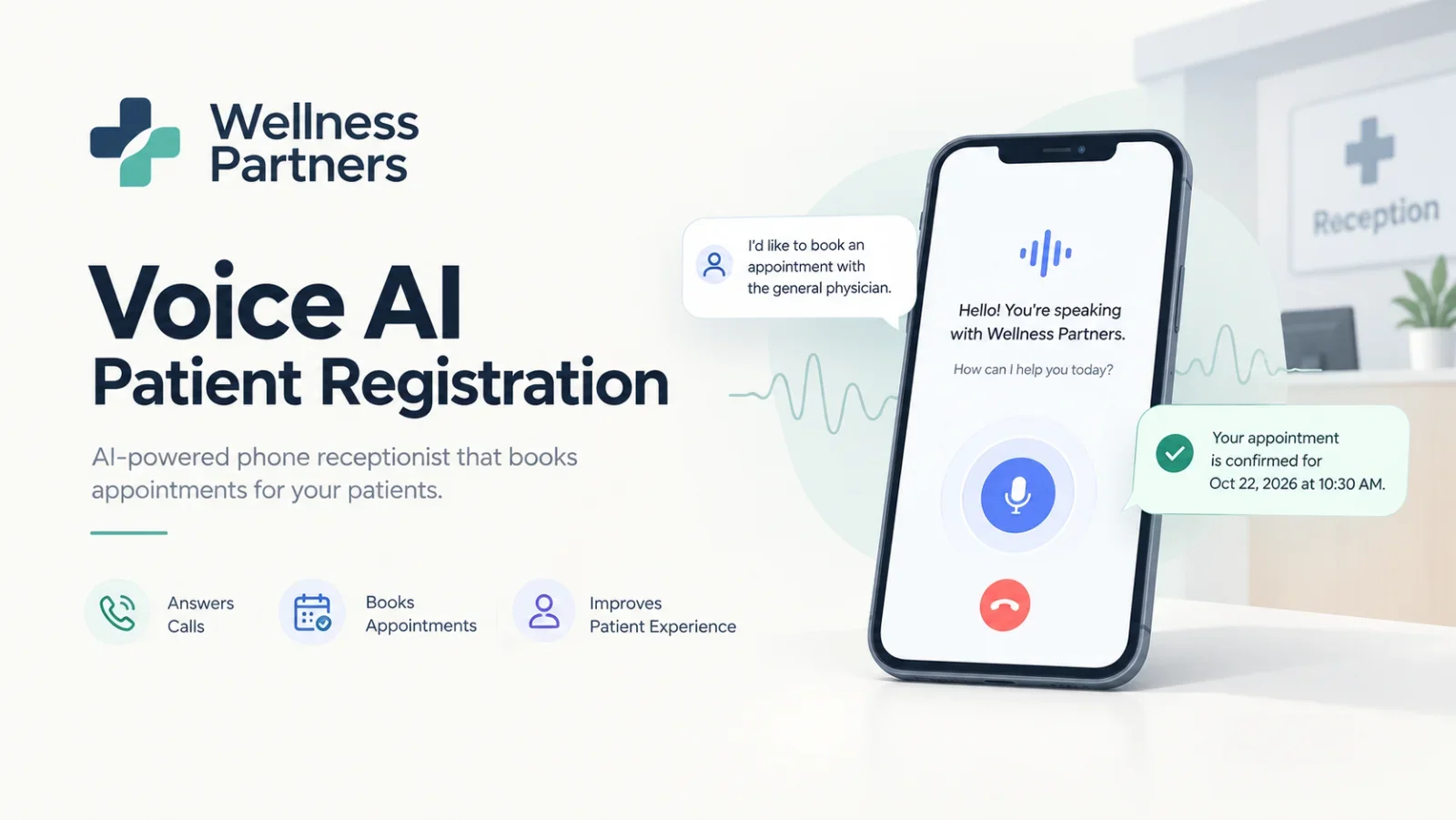
Voice AI Patient Registration is a conversational clinical intake system designed to automate patient registration and demographic record management through natural phone conversations.
The system features Riley, an AI intake coordinator for Wellness Partners. Patients can call a provisioned U.S. phone number, provide their information through conversation, and register or update their existing records without manually filling out forms.
The application connects a real-time Voice AI pipeline with a custom FastAPI backend, deterministic data validation, and Supabase PostgreSQL persistence.
The Problem
Traditional patient intake processes require staff to manually collect demographic information, verify existing records, enter data into databases, and handle updates.
This project explores how conversational AI can automate these repetitive front-desk tasks while maintaining structured, validated patient records.
Solution
I built an end-to-end Voice AI patient registration workflow with the following capabilities:
- Natural Voice Conversations: Patients interact with Riley through phone calls using Vapi's real-time telephony and voice infrastructure.
- Patient Registration: Collects demographic information, contact details, address, and optional insurance information.
- Duplicate Detection: Checks existing patient records using phone numbers before creating a new registration.
- Record Updates: Allows existing patients to update their demographic information.
- Structured Data Validation: Uses Pydantic v2 to validate, sanitize, normalize, and enforce data constraints before database operations.
- Live Admin Dashboard: Provides an auto-refreshing dashboard to monitor patient registrations and records.
- REST API: Exposes endpoints for creating, retrieving, updating, and soft-deleting patient records.
- Multilingual Conversations: Supports Spanish language detection and conversational switching.
Technical Architecture
The application follows an event-driven architecture connecting the voice platform to a custom backend through HTTP webhooks.
- Voice Layer: Vapi manages telephony, speech recognition, conversation flow, and voice responses.
- AI Layer: OpenAI powers Riley's conversational reasoning and custom tool invocation.
- Speech Processing: Soniox RT v5 handles real-time speech-to-text, while Layla v2 provides natural voice responses.
- Backend: FastAPI handles webhook events, custom tool dispatching, REST endpoints, and application logic.
- Validation: Pydantic v2 enforces structured data validation and normalization.
- Database: Supabase PostgreSQL stores patient records with constraints, indexes, triggers, and Row Level Security.
- Deployment: The backend is deployed on Render.
Engineering Highlights
- Implemented custom Vapi webhook integrations and tool dispatching.
- Designed separate tools for checking existing patients, registering new patients, and updating records.
- Built a structured PostgreSQL schema with 19 typed columns and UUID-based primary keys.
- Implemented non-destructive soft deletion and automatic timestamp updates.
- Created standardized API response and error handling.
- Developed an auto-refreshing administrative dashboard.
- Added automated unit and integration tests covering validation, API behavior, and webhook handling.
Results
The project demonstrates a complete Voice AI workflow connecting real-time phone conversations to validated backend operations and persistent database records.
It includes a deployed FastAPI application, live administrative dashboard, REST API, and automated test suite.
Limitations & context
This is a demonstration system built to explore conversational AI in clinical intake workflows. It is not presented as a production-certified healthcare system.
- Speech Recognition: Unusual surnames, email addresses, and complex spellings may require callers to repeat or spell information character by character.
- Latency: More capable language models can introduce additional response latency compared with smaller models. Voice pipeline parameters are tuned to balance conversational quality and responsiveness.
- Deployment: Live phone interactions depend on the configured Vapi assistant, provisioned U.S. phone number, and external service availability.
- Data: The system is designed around sample patient-registration workflows and should not be used with real patient information without appropriate security, privacy, and regulatory controls.